How to overcome resistance to change when clients are exhausted
How to overcome resistance to change in client organizations
You can see it coming. Your client's business model is becoming obsolete, competitors are moving faster, and the warning signs are everywhere. You know what needs to change. You make your case, present your proposal, explain the risks of waiting. But the client resists. Six months later, the company is in serious trouble—or worse, closing its doors. And you're left with the terrible feeling that you saw it coming, knew how to help, and couldn't convince them to act.
So how do you sell change to clients who desperately need it but refuse to act? Organizations need to adapt faster than ever, yet resistance to change is enormous. According to Gartner research, by 2022, employees' willingness to support organizational change had fallen to just 43%—down 31 percentage points from 2016. What's driving this resistance, and what can consultants do to help organizations manage change effectively?
What if resistance to change isn't really resistance?
When employees push back against another transformation, it's tempting to assume they don't understand the urgency—or simply don't want to change. But what if they're already dealing with more change than they can handle?
In a 2026 AQai live poll, 78% of participants reported managing six or more major changes simultaneously, while around 15% had stopped counting altogether. AQai describes a familiar scenario: an organization completes a successful 18-month transformation, yet its teams are exhausted. The new systems are working, the changes have taken hold, but the people responsible for making them happen are running out of bandwidth.
There's a name for this: change fatigue. And it isn't necessarily a problem of motivation or attitude. What looks like resistance may actually reflect a loss of control, fear of the unknown, or exhaustion from previous transformations that never delivered their promised results. Even highly committed employees have limits to how many competing priorities, new processes, and shifting expectations they can manage at once without experiencing change resistance. What looks like resistance from the boardroom may actually be a warning that the organization has reached its capacity to absorb more change.
For consultants, that's an important distinction. You may have a compelling business case, a sound strategy, and leadership support—and still struggle to get the organization moving. The obstacle isn't always a lack of buy-in. Sometimes, it's the inherent resistance to change among stakeholders. Sometimes, there's simply no room for another initiative.
But organizations can't afford to stop changing
If change fatigue is the problem, the obvious solution would be to slow down. Give people time to recover, finish existing initiatives, and restore some stability before launching the next transformation.
There's just one problem: the market isn't slowing down with them.
Reinvention Academy's Global Reinvention Survey has tracked how frequently organizations need to make significant changes to remain competitive. In 2018, 47% of respondents said their organizations needed to reinvent every three years or less. By 2020, that figure had reached 60%. And in 2024, 19.4% reported needing to reinvent every twelve months or faster.
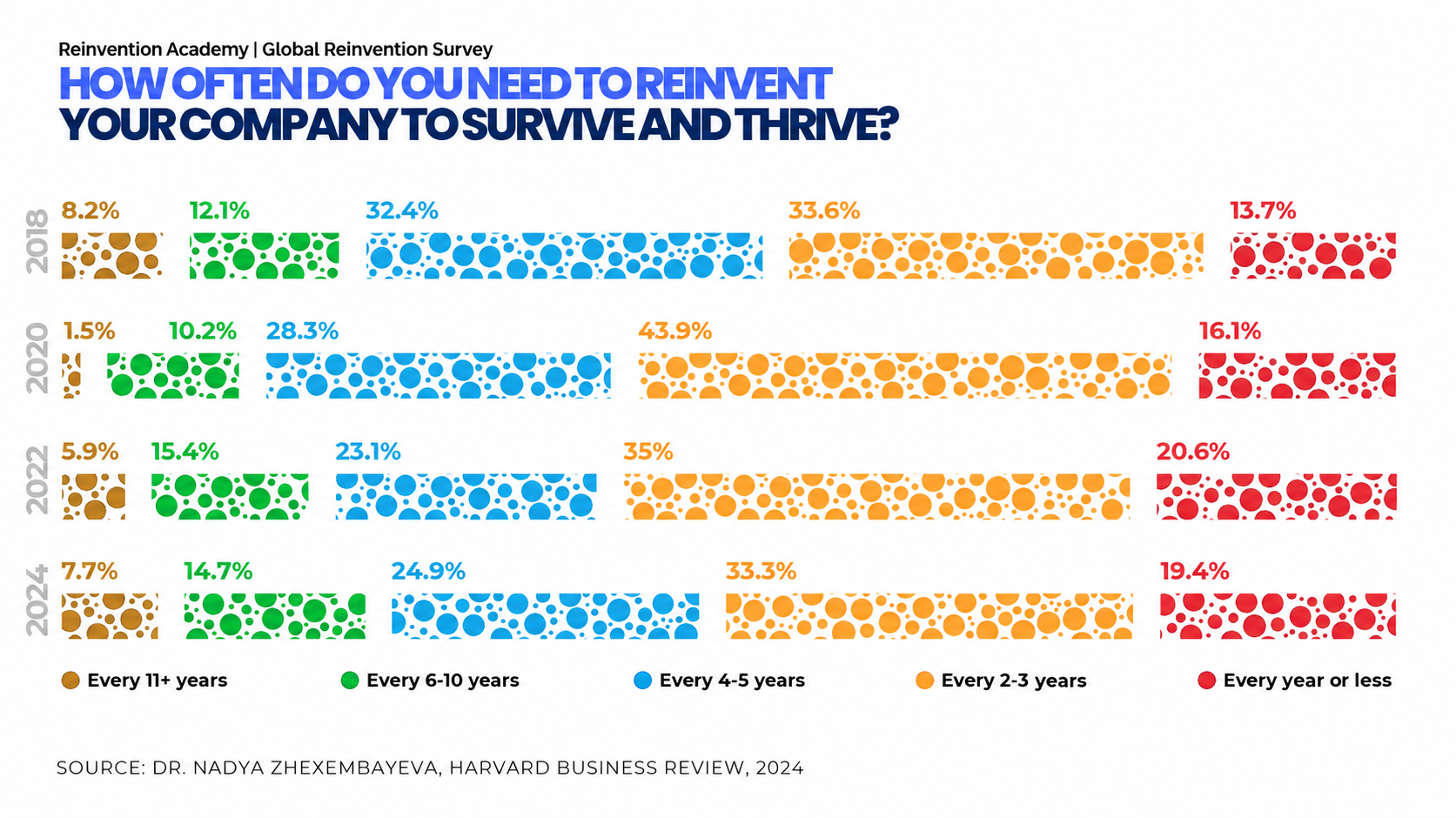
Early findings from our 2026 research suggest the pressure remains structural: more than 54% of respondents reported needing significant reinvention every three years or less. The largest group—37%—identified a two-to-three-year reinvention cycle.
And we're not talking about minor adjustments. Reinvention can mean redesigning products, business models, processes, or entire organizational systems while the existing business continues to operate.
This creates a difficult paradox. Organizations are being asked to change more frequently than their people can comfortably absorb, but postponing necessary change can put their future at risk.
So what should consultants do when both options—pushing ahead and standing still—carry significant consequences?
Why traditional transformation projects are becoming part of the problem
Traditional change management was built around projects with a beginning and an end: launch a transformation, implement the changes, and return to business as usual. That approach made sense when major disruptions were occasional. But today, the next transformation often begins before the previous one is complete, leaving employees with little time to adjust and even less reason to believe things will eventually settle down.
Over time, this creates a dangerous cycle. People become skeptical of new initiatives, hesitate to commit, and sometimes simply wait for the latest strategy to be replaced by the next one. Effective change management requires more than launching initiatives, communicating their benefits, and managing resistance. It means understanding how much change an organization can realistically absorb—and recognizing when the approach itself has become part of the problem. For consultants, that means even a brilliant proposal can be met with resistance—not because the solution is wrong, but because another transformation looks like another burden rather than a way forward.
How to build client buy-in without adding to change fatigue
If your client is already overwhelmed by change, another compelling presentation won't solve the problem. Before asking people to commit to a new transformation, you need to understand what's preventing them from committing in the first place.
1. Start with the reality your client's people actually experience
A CEO may see an urgent need to transform. A middle manager may see three unfinished projects, an understaffed team, and another deadline nobody consulted them about. Both perspectives can be accurate.
Before proposing a solution, talk to the people who will have to implement it—not just the executives approving the budget. When employees feel that decisions are being imposed on them without considering their existing workload, even necessary changes can become a source of frustration. Find out what previous transformations promised, what they delivered, and what employees are afraid of losing this time. The gap between leadership's perception and employees' reality often reveals more about resistance than another readiness survey.
2. Audit the changes already underway
Before introducing another initiative, ask your client to map every major change currently competing for people's time, attention, and resources.
Who owns each initiative? Which teams are affected? Where do deadlines overlap? Which projects depend on the same people?
This often reveals that the organization doesn't lack commitment—it lacks the capacity to execute everything simultaneously. Making these competing demands visible can help leaders prioritize initiatives, manage the transition, and avoid overwhelming the same teams with conflicting deadlines. A consultant who makes that conflict visible can help leaders make better decisions before adding to the workload.
3. Help clients decide what to stop
Not every initiative deserves to survive.
At Beeline Kazakhstan, teams use structured "soft kill" sessions to identify products, features, and processes that should be retired or fundamentally redesigned. In one twelve-month period, the company eliminated five products and reinvented three others.
The principle applies to change initiatives, too. Which programs no longer serve the strategy? Which can be combined? Which should be postponed to free up resources for something more important?
Sometimes, the most valuable thing you can offer a client is permission—and a sound business case—to stop doing something.
4. Let people help design the change
Getting employees to accept a finished transformation plan is much harder than involving them in creating it.
Instead of presenting a predetermined solution, bring the people affected into the process of identifying risks, exploring alternatives, and deciding how implementation should work. This collaborative approach helps build trust by giving people a meaningful role in shaping the changes they will be expected to implement.
One approach I've used with clients is a "Kill the Company" workshop, where employees identify all the ways their organization could fail. It changes the conversation: instead of defending themselves against another management initiative, participants discover why change may be necessary—and help determine what to do about it.
The difference is fundamental. You're no longer trying to overcome resistance after designing the change. You're designing change in a way that gives people a reason to commit.
Stop selling transformation projects. Start building reinvention capability
These approaches can make an individual transformation more manageable. But they don't solve the underlying problem: organizations will need to keep changing long after your current engagement ends.
That's why I believe the future of consulting lies beyond delivering isolated transformation projects. The more valuable offer is helping organizations develop the capability to reinvent continuously.
That requires three connected disciplines:
- Anticipate: Detect market shifts early enough to act before they become emergencies.
- Design: Develop responses with the people who understand the business and will implement the changes.
- Implement: Test, learn, adjust, and scale solutions without turning every initiative into a massive organizational overhaul.
These disciplines must work together. In my consulting experience, I've seen organizations that generated excellent ideas but couldn't implement them, companies that moved quickly without involving their people, and businesses that executed transformations beautifully—only to discover they were solving yesterday's problem.
Continuous reinvention brings those capabilities into one repeatable process, supported by the organization's culture, leadership, systems, and purpose.
The goal isn't constant upheaval. It's to make adaptation a normal part of how the organization operates, rather than an exhausting exception.
What this means for your consulting business
This shift changes more than your methodology. It changes what clients are paying you for.
Instead of arriving with a predetermined transformation program, you can build your consulting offer around three kinds of value:
Diagnosis before prescription. Help clients assess their current position, identify emerging risks, map competing initiatives, and determine which changes actually deserve investment. The first engagement in the change process may be about making a decision—not launching a project.
Facilitation instead of ready-made answers. Bring leadership teams and employees together to examine conflicting priorities, design responses, and make difficult trade-offs. Create a safe space for challenging assumptions and openly discussing what isn't working. Your value comes from helping the organization reach better decisions, not simply transferring your expertise.
Capability-building instead of project dependency. Help clients establish the processes, decision-making routines, and internal skills required to anticipate, design, and implement change repeatedly.
This also creates opportunities for longer-term advisory relationships. Rather than returning only when a new crisis demands a transformation, you can become a partner in helping clients continuously evaluate what's changing, what matters, and what to do next.
You're no longer selling another transformation. You're helping clients become better at reinventing themselves.
Your clients don't need another transformation. They need a better way to change
The next time a client resists your proposal, don't automatically assume you need a stronger argument.
Find out what they're already managing, what previous changes have cost them, and whether your proposed solution will genuinely make their organization stronger—or simply add another initiative to an overflowing agenda.
Because the real opportunity for consultants isn't to persuade exhausted organizations to change more. It's to help them build a sustainable way to keep changing.
And that's a fundamentally different consulting business.


Join 15,000+ professionals reading Reinvention Weekly