What can consultants sell that AI can't?
AI and consultants: What clients will still pay for
Artificial intelligence can now produce in minutes what consulting teams once spent days researching, analyzing, and turning into presentations. Market reports, competitive analysis, strategic recommendations—even entire consulting deliverables are becoming faster and cheaper to produce. And clients are taking notice. According to a 2026 IBM Institute for Business Value study, 71% of surveyed executives say their organizations have already changed how they use consulting services because of AI.
Yet demand for external expertise hasn't disappeared. What is changing is what clients expect to get for their money. When research, analysis, and ready-made answers are increasingly available at a fraction of their former cost, what exactly are clients still willing to pay consultants for? And what should independent consultants be selling instead?
How AI is changing the consulting industry
Not long ago, consulting economics were relatively straightforward. A client needed research, analysis, or strategic recommendations. A consultant assembled the expertise, invested the hours, and delivered the result. Large consulting firms built entire delivery models around this process, with junior analysts handling research and senior consultants turning it into recommendations.
Recently, I was working with an asset management client and needed to research companies that had recovered from serious business decline and visualize their reinvention journeys. What would previously have taken my team several days took less than ten minutes with a customized AI model.
The work still required my expertise to define the problem and evaluate the results. But the production economics had changed completely. As AI tools automate parts of research, analysis, and other traditional consulting work, clients have less reason to pay a premium for the hours behind those deliverables. The question is no longer how much work it takes to produce an answer, but how much value that answer creates.
Will AI replace consultants?
The short answer is that generative AI is already taking over some consulting tasks, but that doesn't mean it will replace the entire profession. Research, data analysis, standard frameworks, and even preliminary strategic recommendations can increasingly be produced with AI. What once required a team of consultants may now require one experienced professional with the right tools. And as clients gain access to those same tools, the value of traditional consulting deliverables comes under pressure.
But producing a recommendation and helping an organization act on it are two different things. In a 2025 IBM/HFS study, 94% of surveyed executives favored consulting models that combine AI with human expertise rather than relying on either alone. The opportunity isn't to compete with AI-powered services on speed or production costs. It's to become more valuable in the parts of consulting that go beyond producing answers. It's to become more valuable in the parts of consulting that go beyond producing answers.
From content consulting to process consulting
For decades, consulting was largely built around what experts knew. Clients hired specialists for their experience, proprietary knowledge, proven frameworks, and ready-made solutions. This is what we call content consulting: bringing answers developed elsewhere and applying them to a new client's situation.
That model worked well when industries changed slowly enough for yesterday's best practices to remain relevant for years. But in a volatile environment, even a successful solution from three years ago may no longer work. And with AI making established knowledge more accessible, simply knowing more than your client is becoming a weaker competitive advantage.
The alternative is process consulting.
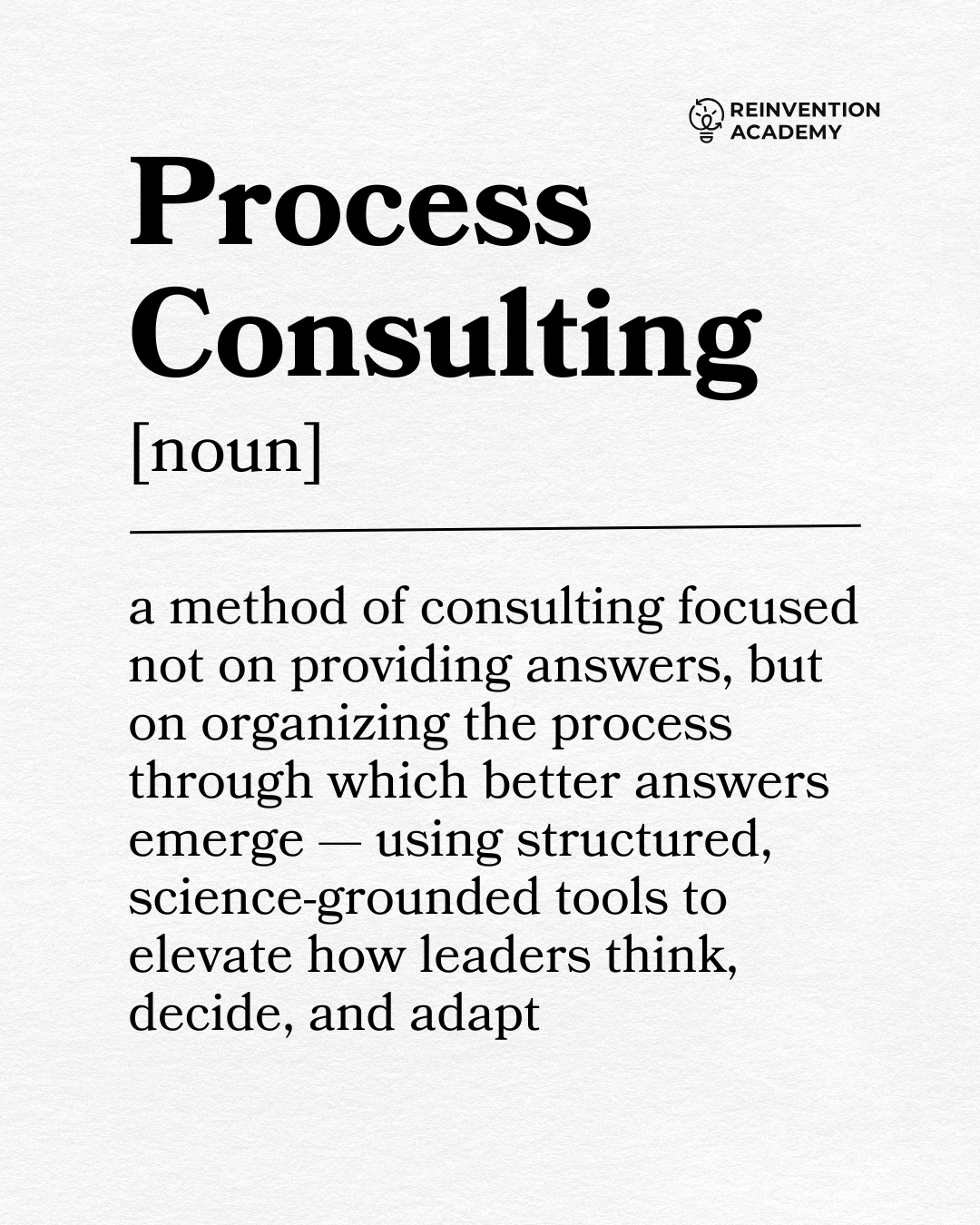
Instead of arriving with a predetermined answer, the consultant helps the client discover the right one. That requires three capabilities: recognizing when no ready-made solution exists, knowing how to find an answer efficiently, and helping the client navigate the uncertainty involved.
This doesn't make expertise irrelevant. It changes how expertise creates value. The consultant's advantage is no longer having all the answers. It's knowing how to help an organization find the right answers—and turn them into action.
What can consultants sell that AI can't?
If the value of consulting is shifting from providing answers to helping clients find and implement them, what does that mean in practice? Here are four areas where consultants can create value that AI alone cannot reliably deliver.
1. Diagnosing the problem clients actually need to solve
Clients often arrive with a solution already in mind. They want a new business strategy, a restructuring plan, or a technology implementation. AI can help produce any of these. But what if the problem they've identified isn't the real problem?
A company struggling with sales may ask for a new marketing strategy when its real challenge is an outdated business model. An experienced consultant doesn't simply execute the request. They question the assumptions behind it, investigate what's happening across the business, and help the client identify where intervention will create the greatest value.
What clients pay for: The ability to solve the right problem before investing in the wrong solution.
2. Facilitating decisions and navigating organizational politics
Even the most sophisticated analysis is worthless if an organization cannot agree on what to do with it.
AI can compare strategic options and recommend a course of action. But organizations are made up of people with competing priorities, different incentives, and unequal influence. A technically sound recommendation may threaten someone's budget, authority, or established way of working.
Consultants create value by understanding these dynamics, facilitating difficult conversations, and helping stakeholders reach decisions they are willing to support. This requires what I call organizational political intelligence: understanding not just what the organization should do, but what it will take to make that decision possible.
What clients pay for: Alignment, commitment, and the ability to move from competing opinions to collective action.
3. Guiding clients through uncertainty
One of the most dangerous things a consultant can do is offer an answer too early.
When leaders face an unfamiliar challenge, they naturally want certainty. And consultants often feel pressure to provide it—even when the information is incomplete and the situation is still evolving. AI can make this temptation stronger by generating convincing recommendations almost instantly. Even sophisticated AI agents can produce plausible options without resolving the underlying uncertainty about which decision an organization should make.
But a plausible answer isn't necessarily the right one. Valuable consultants know when to challenge assumptions, investigate alternatives, and resist the pressure to rush toward a conclusion. They create a structured process for making decisions while the outcome remains uncertain.
What clients pay for: The ability to navigate uncertainty without confusing confidence with sound judgment.
4. Building organizational capability for continuous reinvention
A consultant can deliver an excellent strategy, help implement it, and still leave the client with the same fundamental vulnerability: an organization that depends on outside expertise whenever circumstances change.
In a world of continuous disruption, that isn't enough.
The greater opportunity is to help organizations develop their own capacity to anticipate change, design responses, and implement new solutions. Instead of treating transformation as a one-time project, consultants can help clients establish the processes, skills, and decision-making routines needed to reinvent repeatedly.
This changes the relationship between consultant and client. The goal isn't simply to solve today's problem. It's to make the organization better equipped to confront tomorrow's.
What clients pay for: A lasting capability to adapt—not just another set of recommendations.
How to turn these capabilities into consulting offers
The shift from content consulting to process consulting isn't just about developing new skills. It also means rethinking what you sell, how you structure your engagements, and what clients are actually paying for.
Here are three ways to translate these capabilities into consulting services.
1. Strategic diagnostics and decision-making engagements
Instead of selling a market analysis or strategic report, offer an engagement that helps clients identify their most pressing challenges and make informed decisions about what to do next.
AI can accelerate research, analyze trends, and compare scenarios. Your value lies in framing the right questions, challenging assumptions, and helping leadership decide where to focus its resources.
What you're selling: Strategic clarity and better decisions—not the research hours behind them.
2. Facilitated reinvention engagements
Rather than delivering a strategy developed largely outside the organization, bring stakeholders together to design and test solutions.
This could involve facilitated strategy sessions, business model reinvention workshops, or cross-functional engagements that help teams explore alternatives, resolve disagreements, and develop actionable experiments.
AI can support the process by generating options and synthesizing information. But the consultant guides the conversations, builds alignment, and helps turn competing perspectives into collective decisions.
What you're selling: A structured process that moves organizations from uncertainty to coordinated action.
3. Embedded capability-building and fractional advisory
Instead of limiting your involvement to a single project, consider longer-term relationships focused on helping clients develop their own capacity for continuous adaptation.
This might mean serving as a fractional strategy or reinvention advisor, establishing regular strategic reviews, or helping leadership teams build processes for anticipating change, testing new approaches, and implementing decisions.
The goal isn't simply to help clients use AI more effectively. It's to integrate technology into the judgment, routines, and organizational capabilities they need to adapt continuously.
What you're selling: An ongoing ability to adapt and create value—not another isolated consulting deliverable.
These models also create opportunities to move beyond traditional hourly billing toward project-based, retainer, or outcome-oriented arrangements. The important shift isn't simply how you charge. It's moving from pricing the work you produce to pricing the value you help create.
The most future-proof consulting skill is reinvention
There's one important catch: no consulting service is guaranteed to remain valuable forever. Even the capabilities that differentiate human consultants today will evolve as AI becomes more sophisticated. Building your business around a list of things AI supposedly can't do is simply another way of betting on stability.
I learned this lesson long before the current AI revolution. In 2014, I began reinventing my own successful consulting practice. I had clients, demand, and a business that worked. But I could also see the limitations of a model built around my personal time and expertise. Rather than wait for that model to stop working, I started building what would eventually become Reinvention Academy.
That experience taught me something fundamental about the future of consulting: the most durable competitive advantage isn't having expertise AI cannot replicate. It's knowing how to reinvent your value before the market makes your current offer obsolete.
Stop competing with AI for work AI can already do
AI will continue to take over parts of traditional consulting work. And that's not necessarily bad news for consultants willing to rethink what they offer.
The opportunity isn't to compete with technology on the speed or cost of producing answers. It's to help clients identify the right problems, make difficult decisions, navigate uncertainty, and build the capability to adapt continuously.
The future belongs not to consultants who protect their existing expertise, but to those who keep reinventing how that expertise creates value.
Explore our Reinvention of Consulting Trend Briefing for a deeper look at the forces reshaping the profession—and the opportunities emerging for independent consultants.


Join 15,000+ professionals reading Reinvention Weekly