What Clients Actually Want From Consultants in 2026
Why Clients No Longer Hire Advisors for Answers (And What They Want Instead)
5 min read ·
Aug 12, 2026
The shift is easy to miss—but it changes everything.
Clients haven't stopped valuing expertise. But their reality has changed.
Business leaders are navigating one disruption after another while trying to deliver this quarter's results. Strategies become outdated faster, customer expectations keep shifting, and solutions that worked six months ago may no longer fit today's conditions. At the same time, organizations have neither the time nor the resources for endless transformation projects.
That changes the role of an advisor.
The End of the "Expert Has the Answer" Era
Business decisions used to have a long lifespan.
A strategy could guide a company for years. A successful business model could generate growth for decades. A proven management practice could be repeated with predictable results.
Not anymore.
Today, almost every business decision has an expiration date. Markets shift, technologies evolve, regulations change, competitors emerge, and customer expectations move faster than organizations can adapt.
This is the defining characteristic of the post-stability economy: change is no longer an interruption. It has become the operating environment itself.
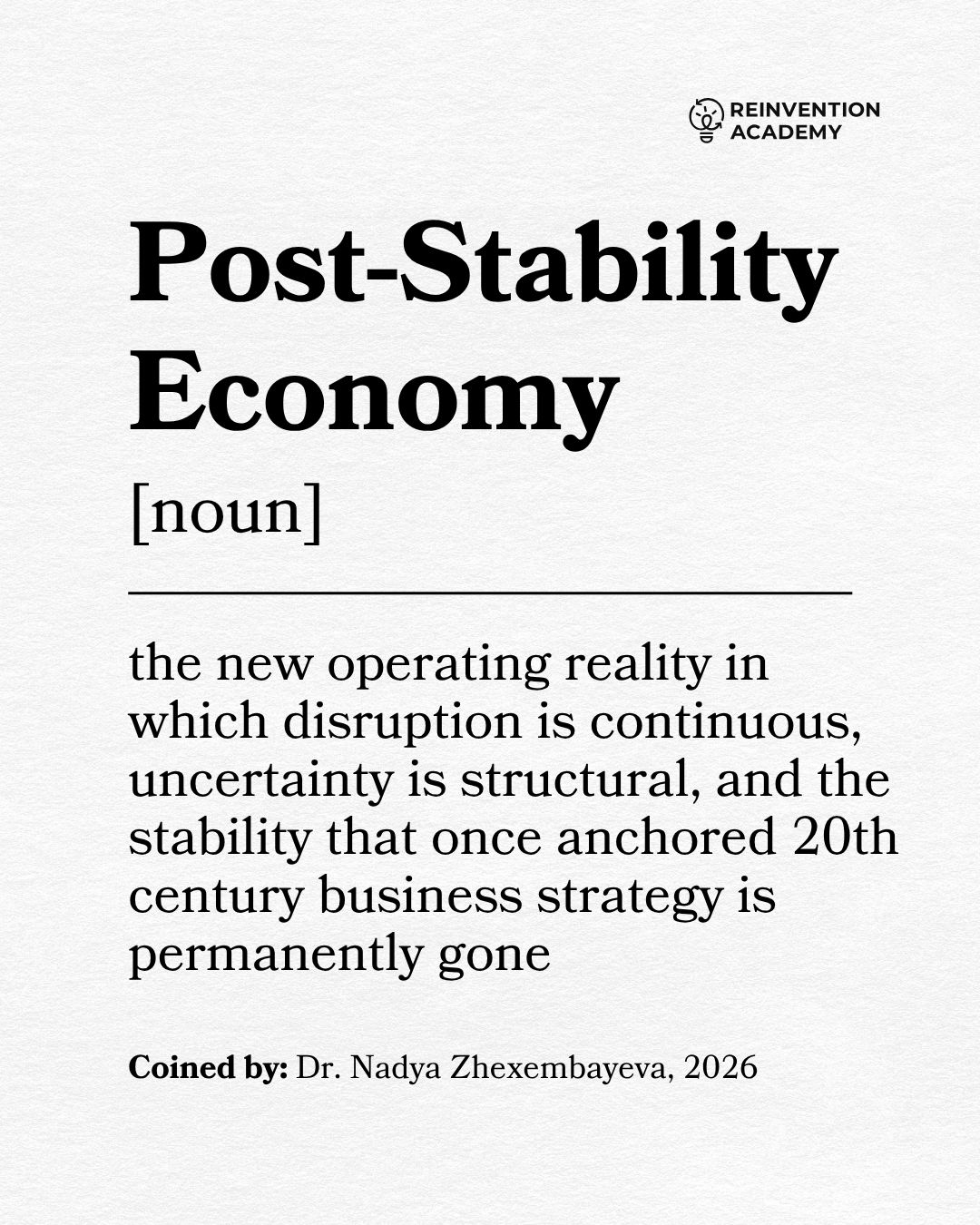
And that's exactly why the era of ready-made answers is coming to an end.
By the time a consultant spends weeks analyzing a problem, preparing recommendations, and presenting the "right" solution, the client's reality may already have changed. The answer was expensive to produce, slow to deliver, and useful for only a short period of time.
Organizations don't have the luxury of waiting for perfect answers anymore. They need a different kind of help.
The Four Capabilities Clients Are Really Buying
The shift isn't that clients value expertise less.
It's that expertise is no longer the outcome they're paying for.
What they're really buying is the ability to make better decisions under constantly changing conditions.
That changes the future of the consulting profession in four important ways.
1. Clarity instead of certainty
Clients know nobody can predict every disruption. What they need is someone who can cut through complexity, identify what matters now, and create enough clarity to move forward.
2. Better decisions instead of better recommendations
A report has little value if the assumptions behind it become obsolete a month later. Clients increasingly value advisors who improve how decisions are made, not just what decisions are made.
3. Faster adaptation instead of perfect planning
The goal is no longer to build a five-year plan that survives unchanged. It's to help organizations notice change earlier, respond faster, and adjust with less friction.
4. Capability instead of dependency
The best advisors don't just solve today's problem. They leave clients better equipped to handle tomorrow's.
Taken together, these capabilities deliver something even more valuable than a recommendation.
The Most Valuable Thing an Advisor Can Offer: Relief
Behind every strategic challenge sits a human one.
Today's leaders aren't suffering from a lack of information. They're carrying the weight of constant uncertainty, competing priorities, and the pressure to make consequential decisions without enough time or complete information.
The best advisors don't add to that burden with more frameworks, reports, or recommendations. They reduce it. They create clarity where there is confusion, make complex decisions more manageable, and help leaders move forward without pretending that certainty exists.
In the post-stability economy, that sense of relief may be the most valuable outcome an advisor can deliver.
Process Consulting Is Becoming More Valuable
This shift is changing not only what clients buy, but how the best advisors create value.
In a stable environment, the consultant's job was to provide answers. In a volatile one, it's to improve the quality of thinking that produces those answers.
That's the essence of process consulting.
Instead of relying on predefined solutions, process consultants use structured methods to help leaders make sense of complexity, surface better options, challenge assumptions, and reach stronger decisions together.
The value no longer lies in having the smartest answer in the room.
It lies in helping the room produce smarter answers.
The Volatility Premium: How Advisors Can Command Higher Fees
Premium fees follow scarcity.
The scarcity is no longer information. It's the ability to help clients succeed in an environment where volatility is permanent rather than occasional.

This is the volatility premium: the additional value organizations place on advisors equipped with tools and frameworks designed for a post-stability economy. Advisors who reduce complexity, improve decision quality, and build adaptability solve a fundamentally different problem than those who simply deliver recommendations. And that difference is increasingly reflected in what clients are willing to pay.
The Value of Consulting Is Being Redefined
Organizations will always need outside perspective, specialized expertise, and experienced advisors. But in a post-stability economy, those qualities become the starting point—not the finished product.
If there's one question every advisor should be asking, it isn't "How do I become a better expert?"
It's "How do I become more valuable in a world where certainty no longer exists?"
.svg)

Join 15,000+ professionals reading Reinvention Weekly